
A fault trips one circuit, not the house
RCBOs on every way mean a faulty appliance or damaged cable isolates only that circuit. Lighting, the freezer and the router stay on while the fault is found.
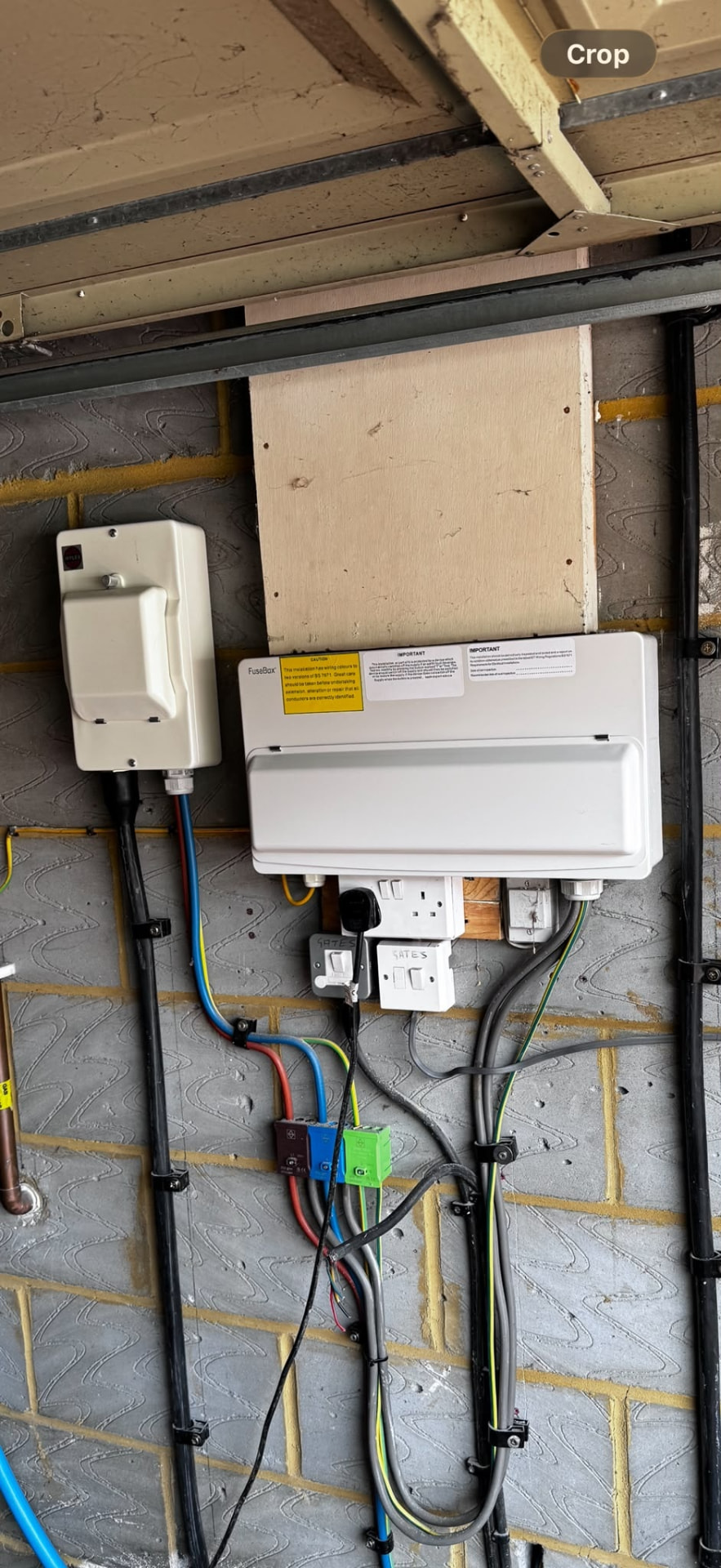
Consumer Unit Replacement
A straight swap of an outdated or damaged fuse board for a modern metal-clad consumer unit with RCBO protection on every circuit, usually completed in a single day, priced by the number of ways before Adam picks up a tool.
From £650 for a 6-way board, straight swap same position. NAPIT Approved Domestic Installer, Reg. 79130, quotes are free.
13 years
On the tools as an electrician
NAPIT 79130
Approved Domestic Installer
From £650
6-way board, straight swap
£2m
Public liability insurance
The service
A consumer unit replacement is the removal of an old fuse board, typically a rewireable fuse box, an early miniature circuit breaker board with plastic housing, or a split-load unit with only partial RCD cover, and its replacement with a modern metal-clad consumer unit fitted with RCBOs on every circuit. RCBOs combine overcurrent protection and residual current protection per circuit, so a fault on one circuit trips only that circuit rather than plunging half the house into darkness.
The work described here is a straight swap: the new board goes in the same position as the old one, using the existing meter tails, existing circuits and existing cable routes. It does not involve adding new circuits, moving the board to a different wall, or upgrading the supply, that is a consumer unit upgrade rather than a replacement, and it is priced and scoped differently.
Before any board is changed, existing circuits are tested. If cabling, earthing or bonding is found to be unsuitable for RCBO protection during that testing, you are told before work proceeds, not afterwards. A replacement board does not fix bad cable; it protects a customer far better against the faults that bad cable eventually produces.
Pricing is fixed by the number of ways in the new board: £650 for a 6-way, £800 for an 8-way, £850 for a 10-way and £900 for a 12-way, all as a straight swap in the same position. Anything outside that, relocating the board, adding capacity, or working around an unusual meter arrangement, is quoted individually once the site has been seen.
Rewireable fuses, missing RCD protection or a plastic consumer unit are among the most common C2 findings on an Electrical Installation Condition Report, and a replacement clears them in a single visit.
Amendment 3 of BS 7671 requires metal or metal-clad enclosures for new consumer units due to fire risk from arcing faults. Older plastic boards are not automatically unsafe, but replacing one removes that specific risk outright.
A single RCD protecting the whole board means one faulty appliance trips everything. Individual RCBOs isolate the fault to one circuit, so the rest of the house stays live.
What happens if it waits
A fuse board can look fine on the wall for years while the protection behind it has fallen well short of what a modern installation needs.
Many rewireable fuse boards and early split-load units offer no residual current protection on socket circuits. A fault to earth through a person is not detected quickly enough, which is precisely the scenario RCD protection exists to prevent.
A split-load board with one RCD covering multiple circuits means a fault in the kitchen can cut power to lighting, upstairs sockets and the freezer in one go, with no way to isolate the actual problem quickly.
Plastic consumer units have been implicated in house fires where an arcing fault ignited the enclosure itself. This is the specific reason current wiring regulations require metal enclosures for new installations.
Fuse wire gets substituted with whatever is to hand, sometimes higher-rated wire, sometimes none at all, which quietly defeats the overcurrent protection the fuse was there to provide.
Some insurers and lenders ask about consumer unit type and RCD protection directly. An old fuse board can complicate a remortgage or a claim in ways that are easy to avoid in advance.
An outdated board frequently generates a C2 on inspection. Left until a sale is in progress or a tenancy is due to start, the replacement becomes a rushed job rather than a planned one.
How it works
Adam looks at the current board, the meter tails, the number of circuits and their condition, and confirms whether a straight swap is realistic or whether something else needs discussing first.
Price is confirmed by the number of ways needed, 6, 8, 10 or 12, before any work starts, based on a same-position, straight-swap install.
Each circuit is tested for continuity and insulation resistance before the old board is removed, so any pre-existing cable issue is identified rather than discovered mid-job.
The old unit is removed, the new metal-clad board with RCBOs is fitted in the same position, and every circuit is reconnected and labelled clearly.
The completed installation is tested end to end, an Electrical Installation Certificate is issued, and the notifiable work is registered through NAPIT.
What you get
RCBOs on every way mean a faulty appliance or damaged cable isolates only that circuit. Lighting, the freezer and the router stay on while the fault is found.
A straight swap on an existing installation with sound circuits is normally a one-day job, with the power off in a single planned period rather than spread across a week.
£650, £800, £850 or £900 depending on ways needed. No surprise add-ons for a like-for-like swap in the same position.
A metal-clad enclosure with RCBO protection throughout satisfies the requirements introduced under Amendment 3 of BS 7671 for new consumer units.
Missing RCD protection, plastic enclosures and rewireable fuses are among the most frequent C2 codes, a replacement addresses them directly.
Work is certified and registered as notifiable, giving you paperwork that stands up for insurers, buyers and future inspections.
In detail
Not every board swap is identical, even at the same fixed price. Here is what genuinely changes the job on the ground across Fleet and the surrounding area.
Every circuit feeding into the old board is tested for insulation resistance and continuity before it is removed, while there is still a working reference point to compare against. This catches degraded cable, poor earthing or an already-faulty circuit before the new board is connected, rather than after, at which point it looks like a problem with the new installation rather than what it actually is.
This matters most in properties with older cabling: if a circuit is borderline, you are told before the board goes in, not left to find out when an RCBO trips repeatedly the following week. In the rare case a circuit genuinely cannot take RCBO protection safely as-is, that is flagged and discussed rather than quietly bypassed.
The quoted prices, £650, £800, £850, £900, assume the new board goes in the same physical location as the old one, uses the existing meter tails and existing circuit cables, and needs no additional circuits. This covers the large majority of domestic replacements.
It stops being a straight swap when the board needs to move to a different wall or a more accessible spot, when the meter tails themselves need upgrading to suit a higher-rated board, or when circuits need splitting or adding because the existing arrangement is genuinely unsafe to carry forward unchanged. Any of those is scoped and priced separately once seen, rather than folded silently into the base price.
Board size is determined by the number of circuits actually present, plus a small allowance for spare ways where sensible, not by guesswork. A typical 2 or 3-bed terrace with lighting, ring finals, cooker and immersion circuits often fits comfortably on a 6 or 8-way board. Larger detached properties with garage supplies, outbuildings, multiple heating zones or an EV supply already in place often need 10 or 12 ways.
Choosing a board with a couple of spare ways is sensible where the cost difference is small, since it avoids a second visit later for a minor addition. It is not padded into the quote as standard, the recommendation is based on what is actually on the wall.
Once testing is complete, you receive an Electrical Installation Certificate covering the new consumer unit and the circuits connected to it, and the work is registered through NAPIT as required for notifiable electrical work under Building Regulations Part P.
The new board is labelled clearly so each way is identified by what it feeds, which makes it far easier to isolate a specific circuit safely in future rather than switching everything off to be sure. Where an existing circuit was found to be genuinely unsuitable for the new protection during testing, that is documented and quoted for separately rather than left unresolved on a certificate that implies everything passed.
Not sure which one you need? Start on the homepage or send the details for a free quote.
Common questions
As a straight swap in the same position: £650 for a 6-way board, £800 for an 8-way, £850 for a 10-way and £900 for a 12-way. Moving the board, adding circuits or upgrading meter tails is priced individually after a site visit.
Most straight-swap replacements on an existing installation with sound circuits are completed in a single day, with the power off in one planned period.
Yes. Circuits are tested for continuity and insulation resistance before the old board is disconnected, so any pre-existing issue is identified and discussed before the new unit is connected.
Current wiring regulations require metal or metal-clad enclosures for new consumer unit installations due to fire risk in plastic units. All replacements are fitted with metal-clad boards as standard.
The supply is off for the period the board is being changed and reconnected, typically a matter of hours within the day rather than the whole day, though timing depends on the number of circuits.
No. A replacement is a like-for-like swap in the same position using existing circuits. An upgrade adds capacity, extra ways, surge protection or additional RCD arrangements, and is scoped and priced separately.
In most cases, yes, missing RCD protection, plastic enclosures and rewireable fuses are common C2 findings that a modern RCBO board directly addresses. Any separate cable or wiring issue found would need its own fix.
Emergency call-outs are available on weekdays and some Saturdays, not Sundays. If a board has failed or is unsafe, call and the earliest realistic slot will be confirmed, the phone is answered every day.
Yes. Jackson's Electrical Contractors is a NAPIT Approved Domestic Installer, registration 79130, holding NVQ Level 3 in Installing Electrotechnical Systems and Equipment and a passed AM2 assessment, with £2 million public liability and £250,000 professional indemnity cover.
Bank transfer is preferred, with a deposit required on larger jobs but not typically on a standard board swap. Coverage includes Fleet, Farnborough, Aldershot, Guildford, Farnham, Camberley, Ascot, Yateley and Sandhurst.
Free, no-obligation quote
Tell Adam the number of circuits on your current board and whether it needs to stay in the same position, and you will get a fixed price straight away with a realistic date to get it done.